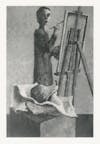
In continuation of a decade of PPP, the gallery presents Lenz Geerk's signed intaglio print series, A Painter Painting A Painting.
Geerk's compositions emerge from a deliberate meditation on the act of creation itself: A recursive inquiry into what it means to observe, to render, to be rendered. The series takes its conceptual genesis from PPP's own iterative naming, that playful tautology which collapses artist, process, and product into a singular, self-reflexive gesture. Yet within this seemingly simple premise, Geerk locates something altogether more elusive: the quiet psychology of making, the vulnerability inherent in the studio's solitude.
The central figure in Geerk's prints is reminiscent of an historical photograph of sculptor , (of whom Geerk greatly admires). Her hand poised mid-gesture above clay, caught in that suspended moment between intention and form. Roeder, an artist whose career navigated the ruptures of early twentieth-century Germany, whose work balanced classical restraint with modernist disruption, appears here not as subject but as cipher. Her presence evokes the artist as both author and artifact, simultaneously creating and being observed, a doubled consciousness that recalls John Berger's meditation on the act of seeing: that to be looked at is to be known differently, to exist in relation to another's gaze.
Geerk's formal language, however, draws equally from the botanical stillness of Barbara Regina Dietzsch, the eighteenth-century Nuremberg painter whose meticulous renderings of flora possess an almost devotional quietude. In rendered with scientific precision yet imbued with an inexplicable melancholy, Geerk finds a kindred approach to observation. There is in both artists' work a similar patience, a willingness to let form emerge slowly, to honour the space between looking and understanding. Dietzsch's compositions, cloaked in velvety blacks and rendered in gouache with near-photographic fidelity, suggest that stillness itself can be a mode of intensity.
The intaglio process, with its labor-intensive reversals and its reliance on pressure, on ink forced into incised fields, mirrors this contemplative stance. Each print bears the trace of the artist's hand twice over: first in the drawing, then in the pressing. The medium itself insists on slowness, on accumulation, on the acknowledgment that making is always a form of marking time.
In A Painter Painting A Painting, the recursive structure of the title folds back upon itself, much like the mise en abyme effect of holding a mirror to a mirror. The work asks: what does it mean to depict the act of depiction? To stand outside the frame while simultaneously inhabiting it? Geerk's prints do not answer these questions so much as suspend them, offering instead a series of meditations on presence, on the artist's body in space, on the studio as both sanctuary and site of exposure.
The series joins a lineage of artists, from Vermeer's The Art of Painting to Velázquez's Las Meninas, who have turned the lens inward, who have made the studio itself a subject worthy of scrutiny. Yet where those baroque precedents often centered masculine authority and theatrical display, Geerk's invocation of Roeder suggests something quieter, more uncertain. Here, the artist at work is neither heroic nor assured, but simply present, caught in the dailiness of the studio, in the unglamorous labor of bringing something into being.
What emerges is less a statement than a question left hanging in the air like Dietzsch's moths against their velvet void: how do we hold the weight of being seen while we ourselves are looking?
References
1
2
3
Intaglio printing technique
4
Vermeer - The Art of Painting
5
Velázquez - Las Meninas
Lenz Geerk, A Painter Painting A Painting