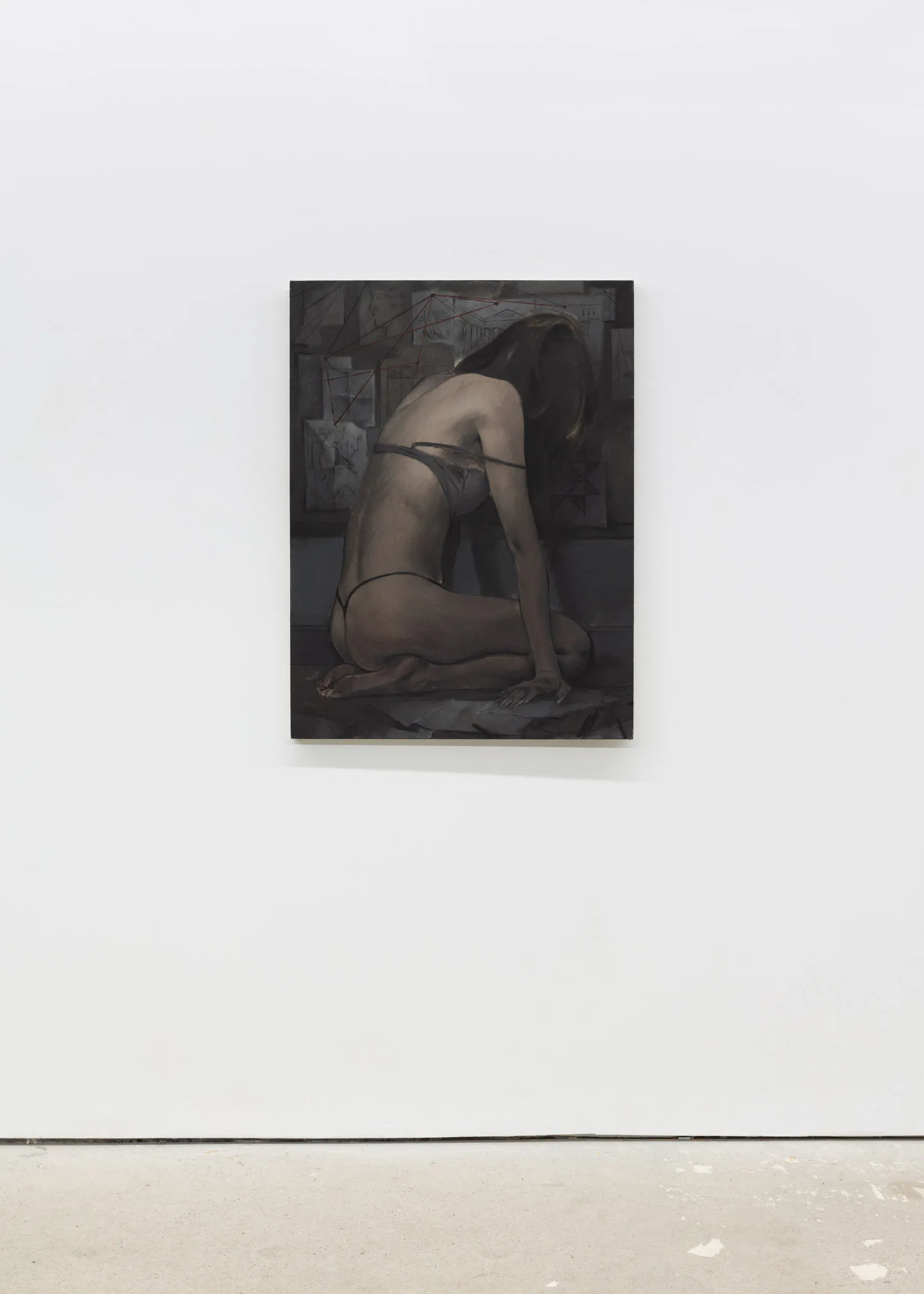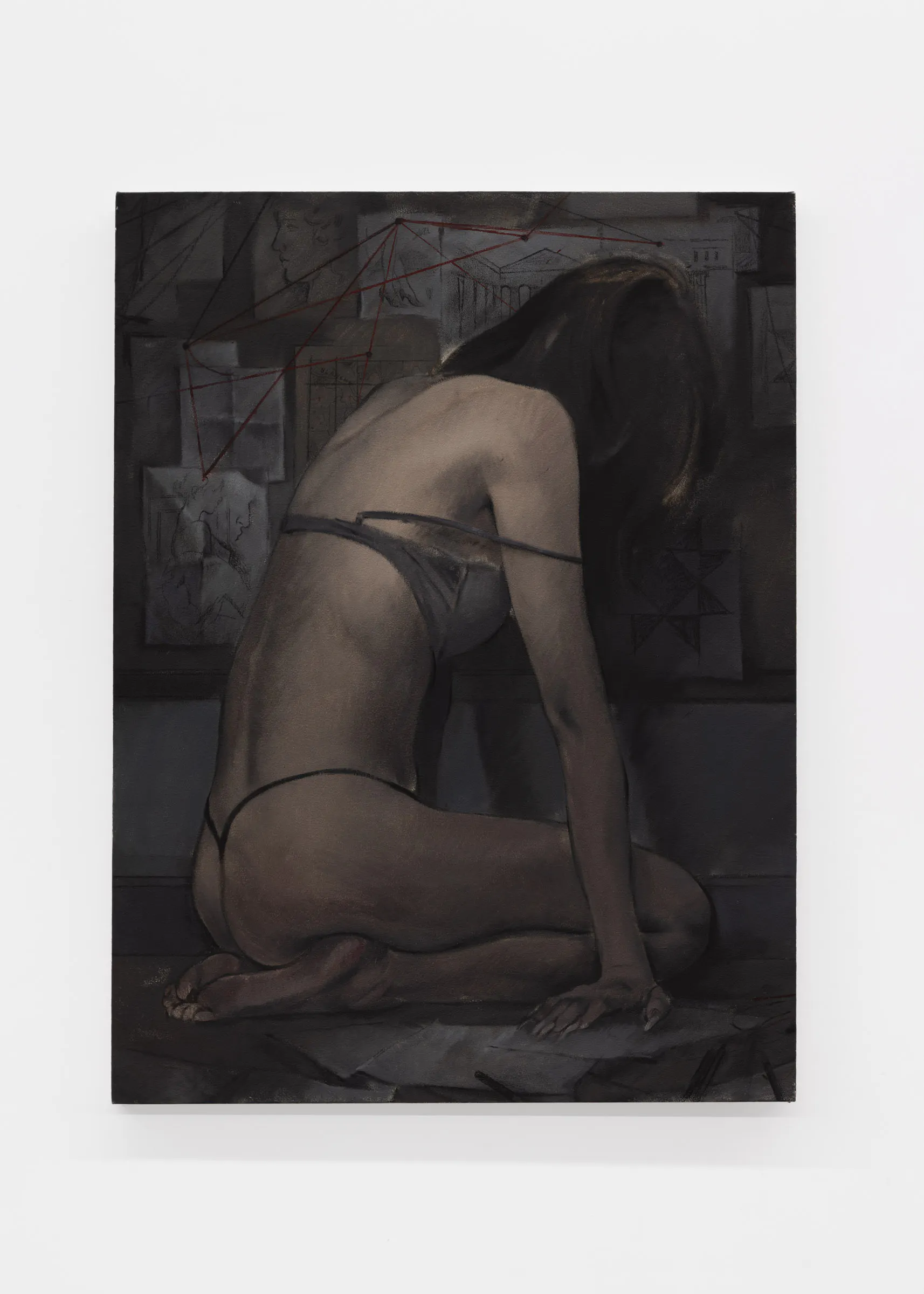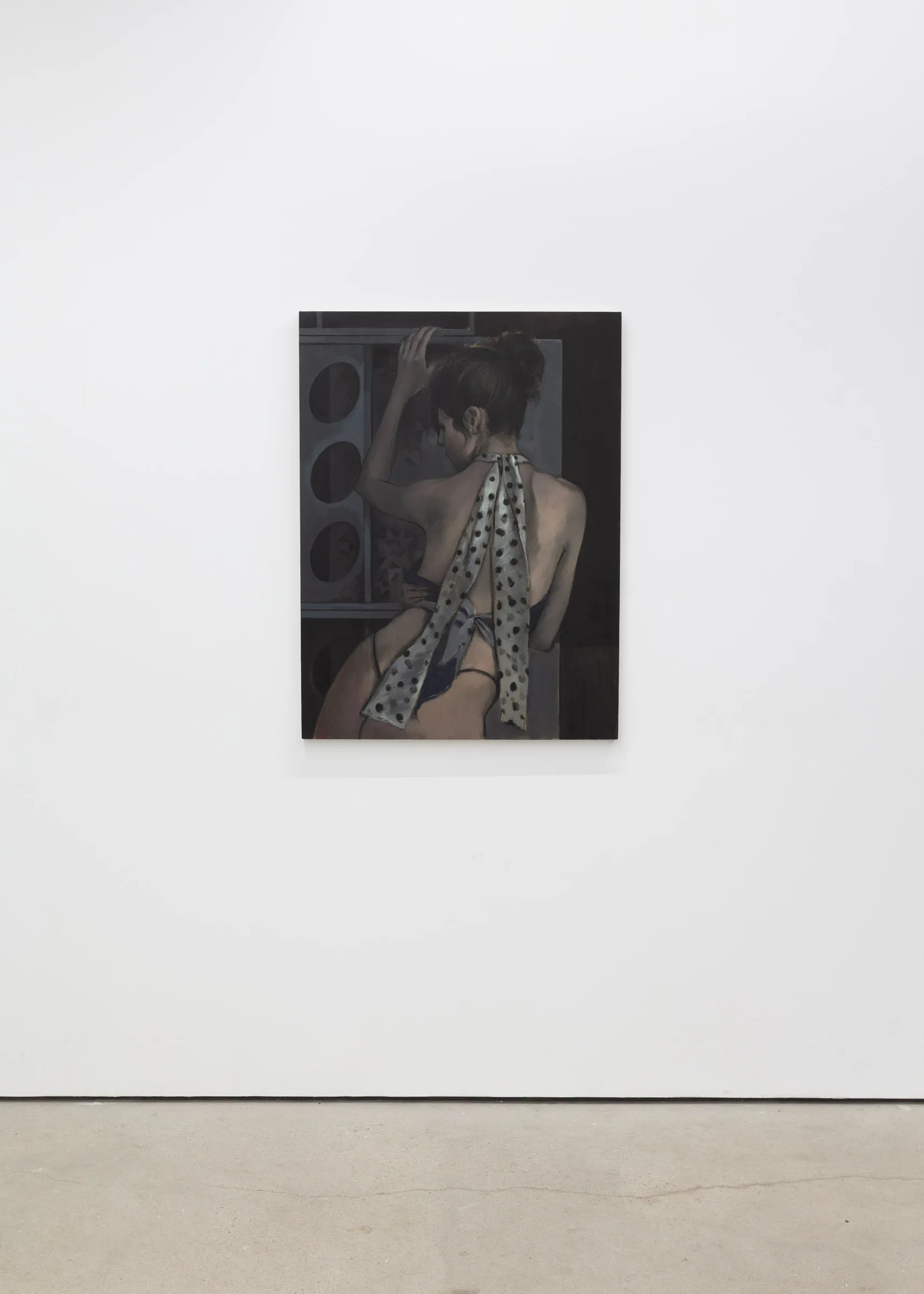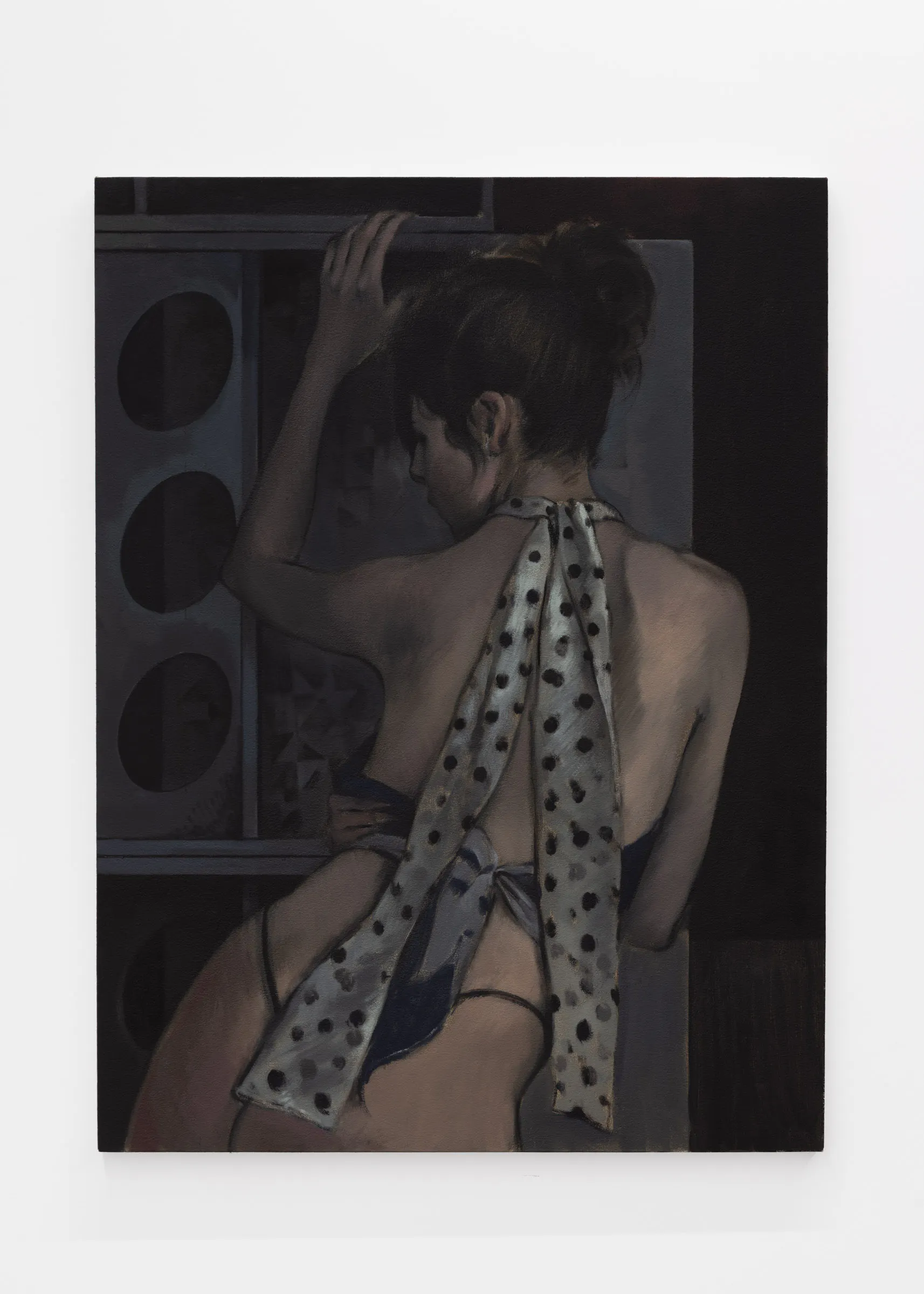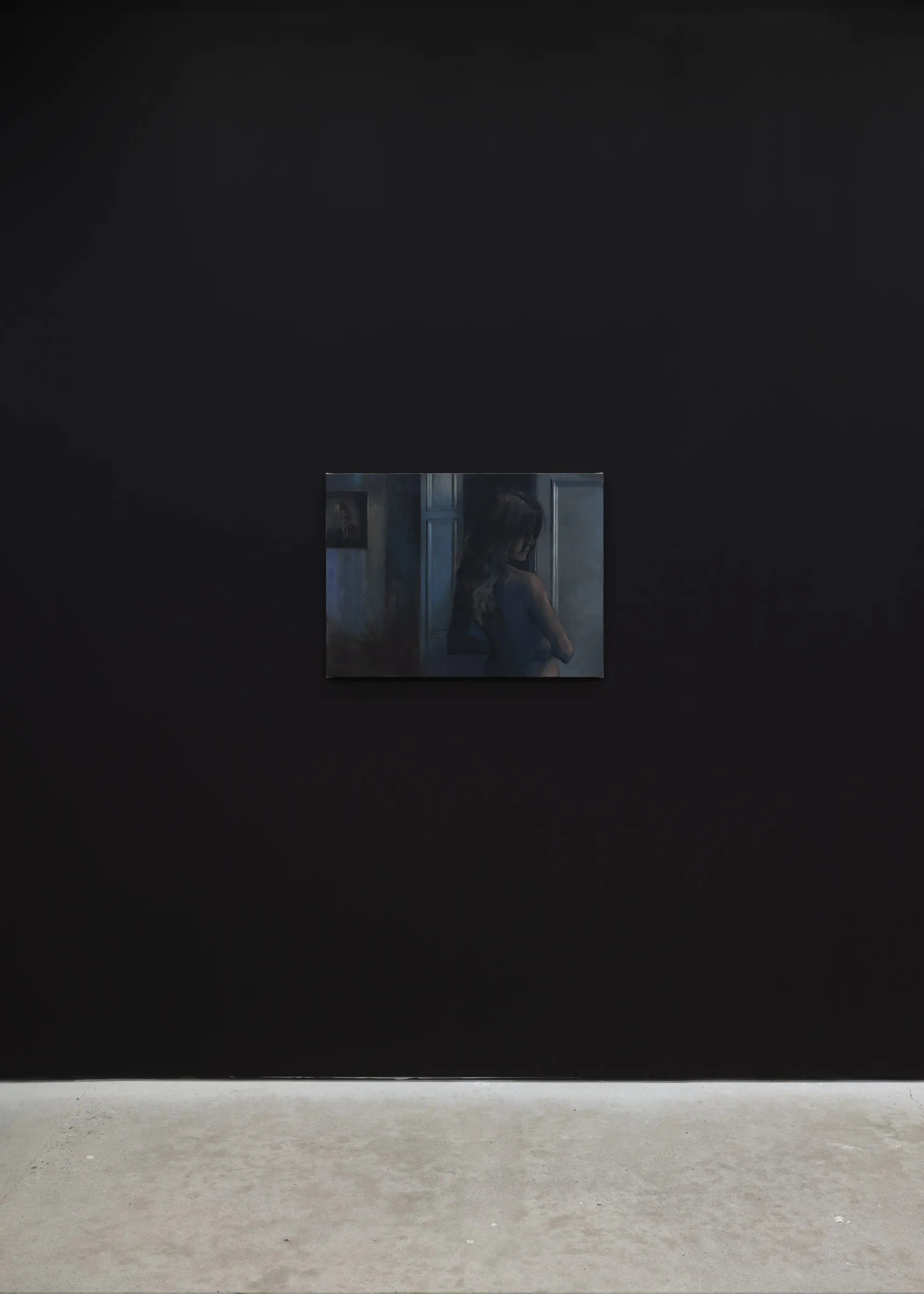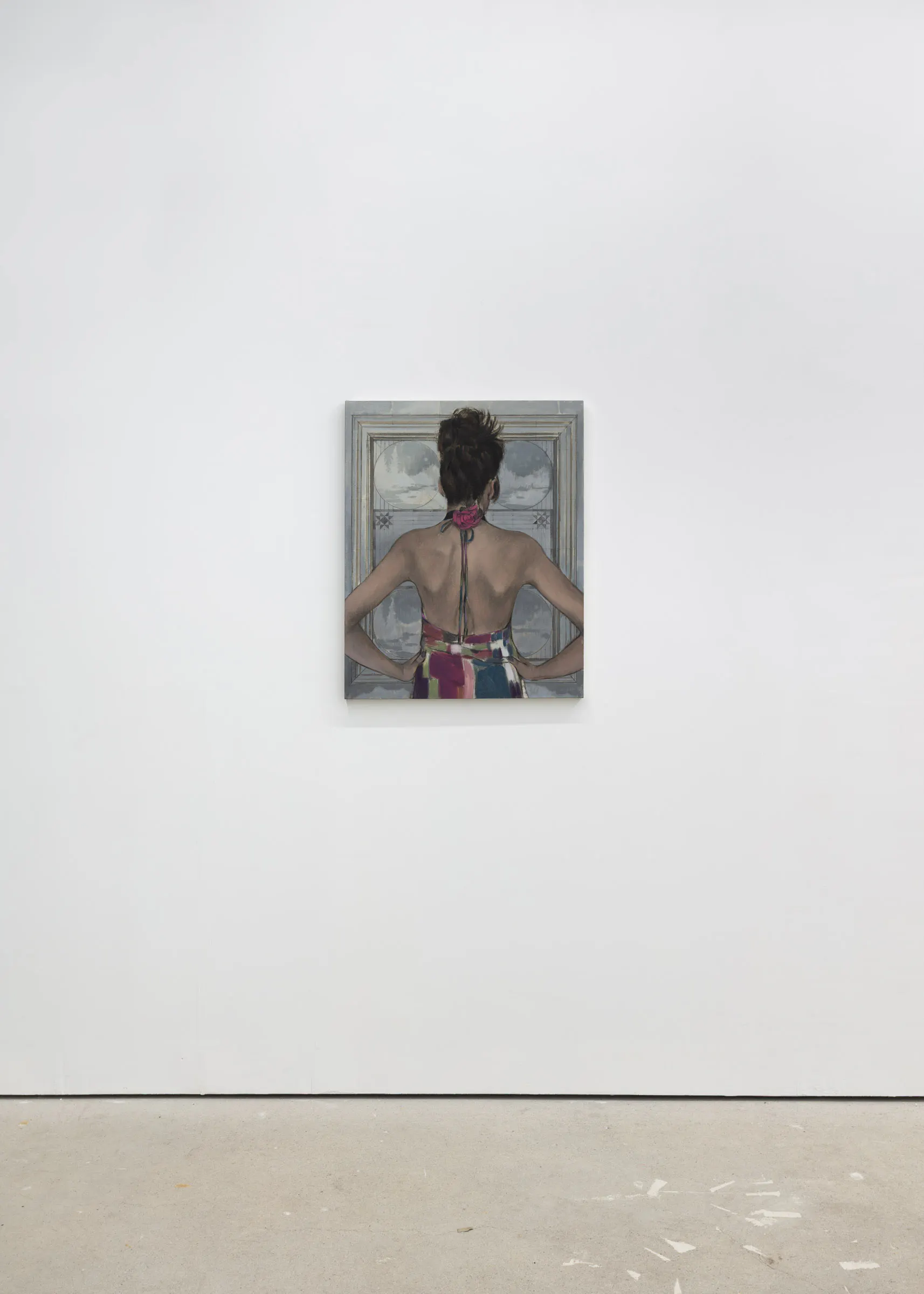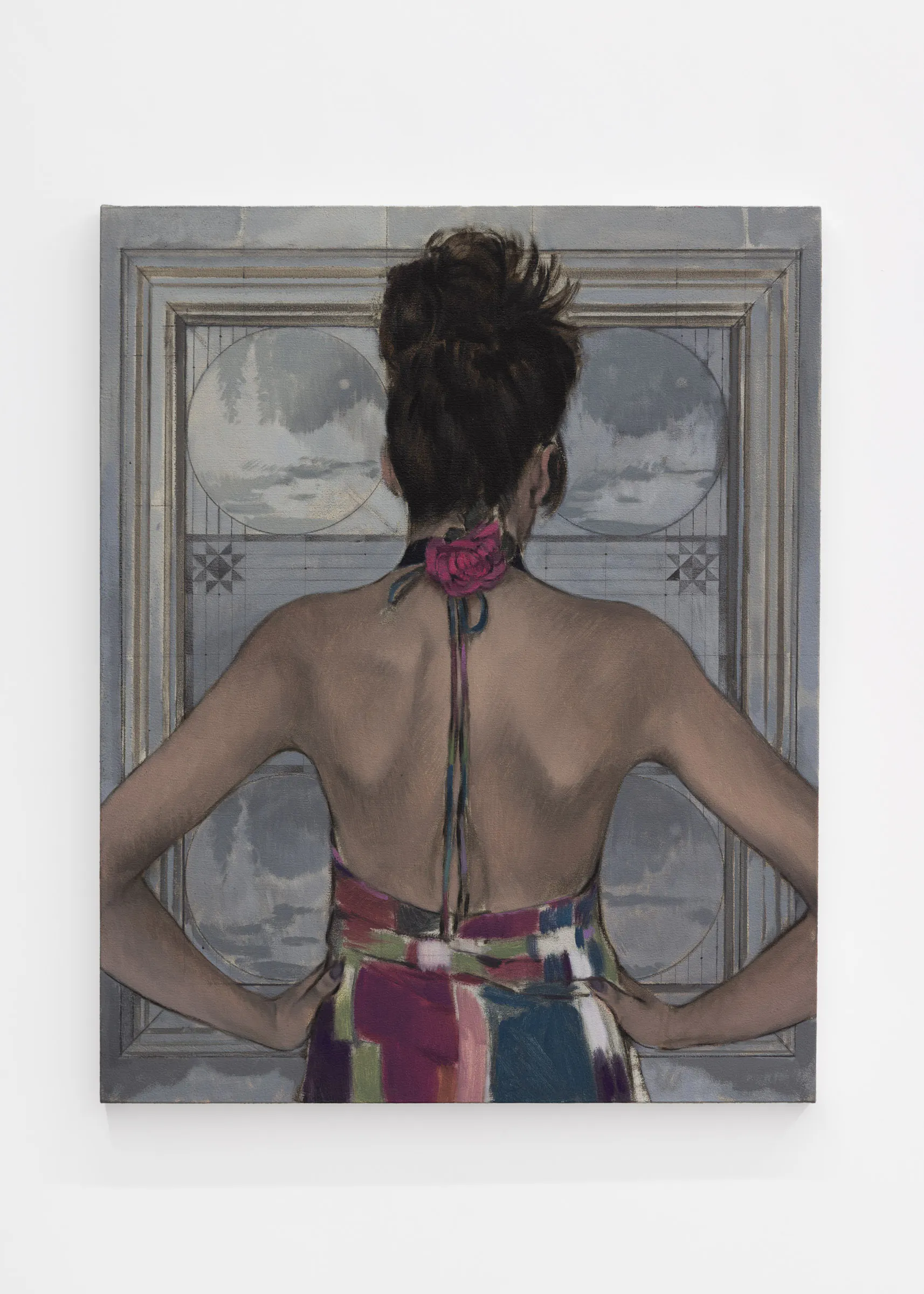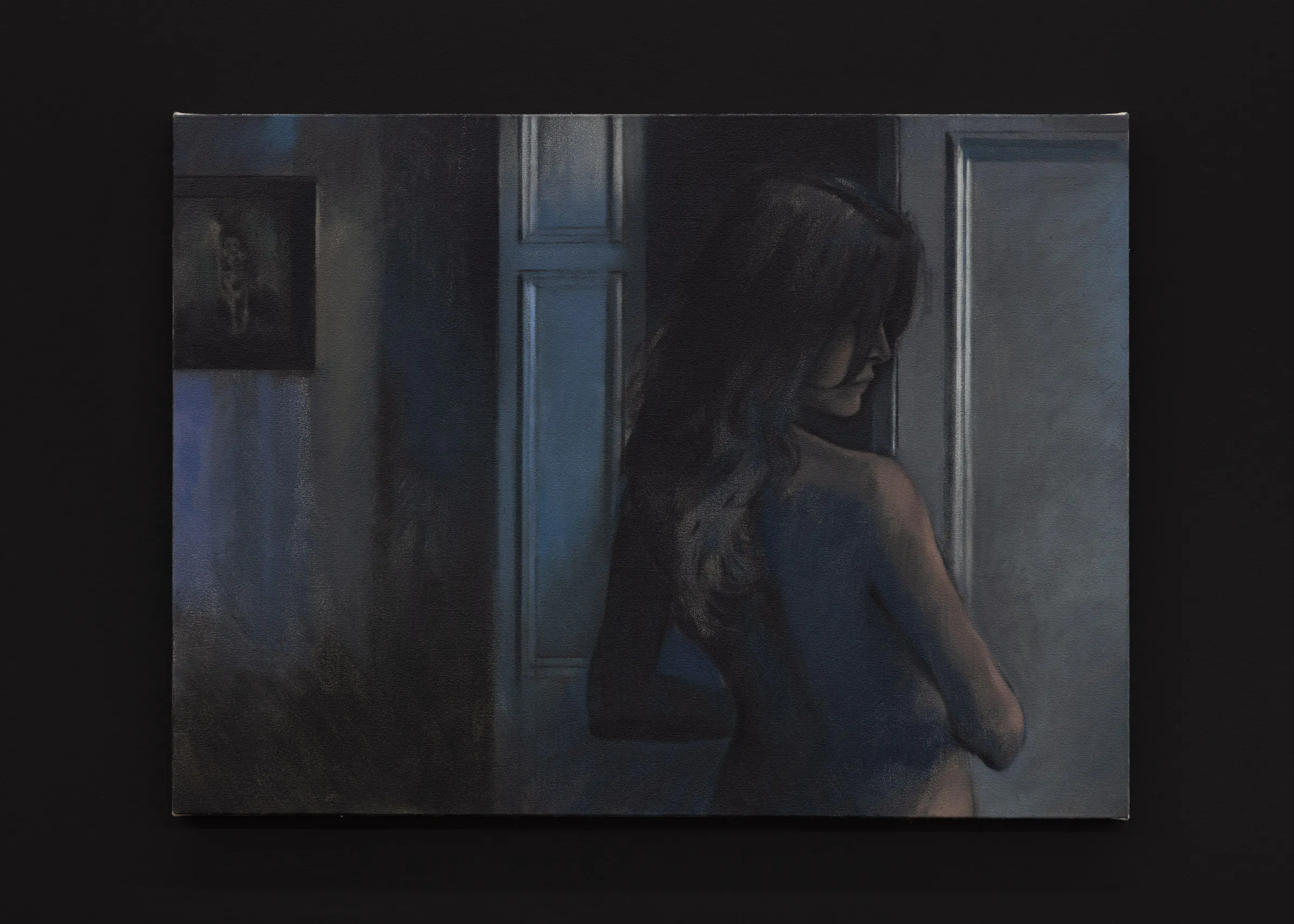
Operating between a dark, moonlit verdancy and cold, interior cornicing, Marriott’s paintings navigate the psychic dissonance between the rural and the urban. In [X], a central protagonist hunches against an exterior landscape of river, trees, and rushes. The stark illumination of her shoulder blades stands in uneasy juxtaposition to the flatly lit openness of the adjacent environment, creating a yawning distance between the two. The painting’s modal register – somewhere between dream, memory, and longing – is underscored by an opaque grey plane at the upper edge, a framing device that further complicates the protagonist's relationship to space. This quiet sense of placelessness hums throughout the compositions in The Sphinx.
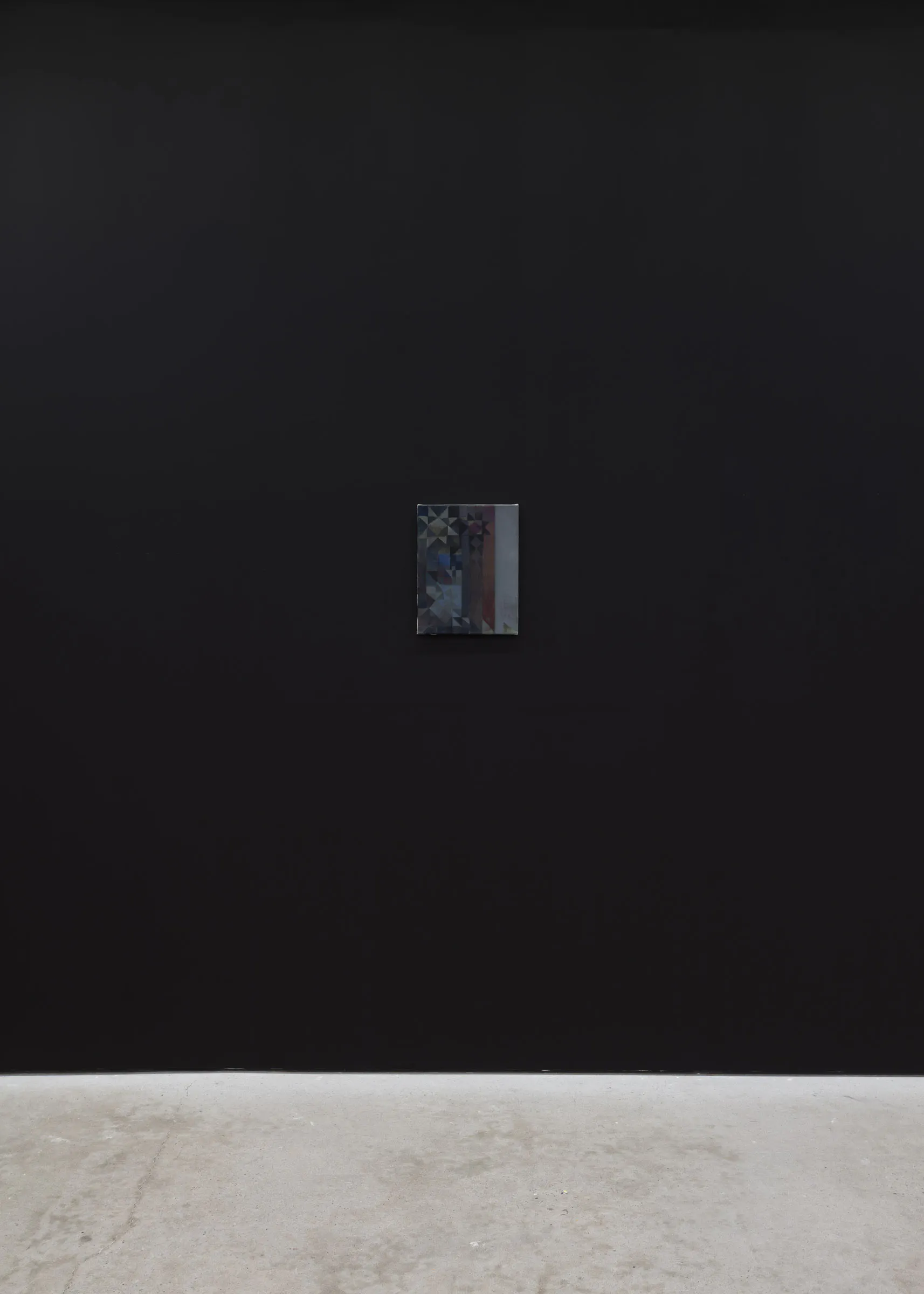
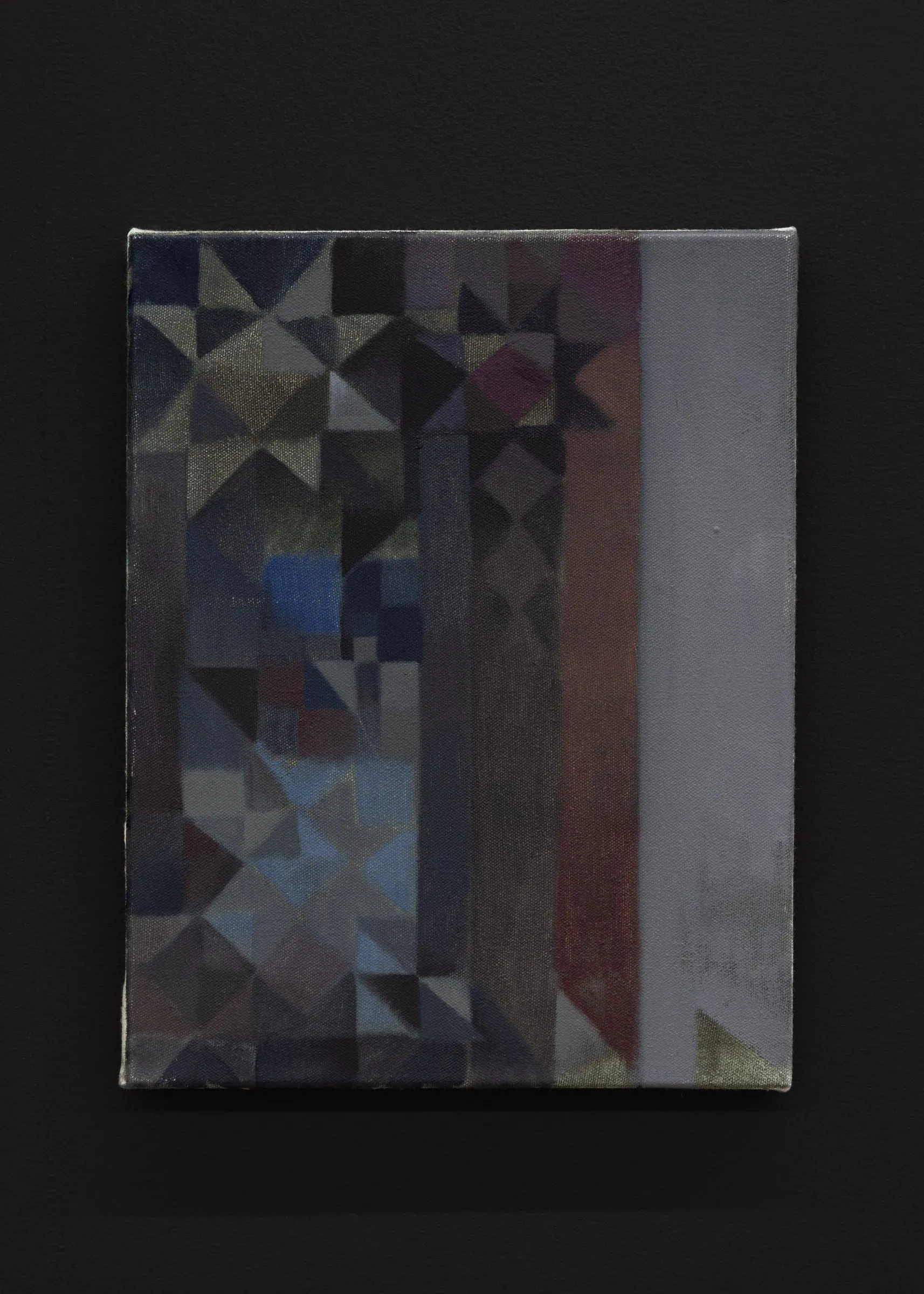
While often read through a confessional lens – owing in part to the recurring presence of the artist’s close collaborator, Silver – Marriott’s paintings resist direct autobiography in favour of what the artist terms a personal mythology. Here, the influence of the Symbolist painters is clear: Fernand Khnopff’s dreamy Gothicism and psychological introspection; the mythic framing of Edward Burne-Jones’ jewel-like compositions delighting in the disjunct between the mythic and the real; Alex Colville’s strange, realist, and frozen flatness. Working within this legacy, Marriott creates her own contemporary vocabulary of symbols which repeats throughout the works: the quilt motif – a symbol traditionally painted on barns across rural Ontario as a form of vernacular heraldry – carries a glimmering presence, refracting continually at the works’ edges; the dark geometry of circular club speakers resounds throughout; and the recurring presence of the central figure sashaying throughout the tableaus, her face perpetually disguised with Romantic anonymity.
Marriott is also influenced by the work of German artist Hans Bellmer, whose studies of dolls and constricted bodies creates a formal and philosophical antecedent. Bellmer’s refusal of authoritarian aesthetics – his insistence on the mutability and transgression of the body, and particularly his engagement with childhood and passivity – chimes with Marriott’s exploration of new modes of identity and myth.
While Marriott’s earlier works drew more directly from a ‘sludge’ of online imagery, this body marks a decisive shift, created with reference to the artist’s own photography, which is then digitally edited and painted on panel. The artist often composes the works using a grid system, which echoes not only the linear quilt motifs but also the partitioned geographies of Northern Ontario in the form of the work. The repeated presence of the quilt motifs also engages with a Cubist impulse – no more clearly than in [Y] – which is significant, given Cubism's ability to reconfigure topography. Working in (and against) the context of traditional Canadian landscape painting, Marriott’s compositions gain power in their disparate, fractured, and contingent relations to space, refusing the coherence of a unified national identity.
Navigating fragmentation and dislocation, intimacy and exposure, body and topography, Marriott’s works create a ruminative, personal register, Sphinx-like in its ability to articulate transitory states of being and belonging.
Written by Lydia Earthy
Marni Marriott, The Sphinx