Raelis Vasquez’ body of work emerges from a concentrated period of making during the PPP- Oostmeijer Residency in Amsterdam, two years ago. Operating between modes of documentary, nostalgia, and reverie, these saturated, tender paintings carry the imprint of multiple geographies: the memory-saturated landscapes of the Dominican Republic, and particularly Mao, the town where Vasquez grew up; the atmospheric lineage of Amsterdam, in quiet conversation with its painterly masters; and Vasquez’ current presence in the United States, bringing with it corollary questions of belonging.
At their centre, Vasquez’ paintings reflect on migration and identity: what it means to live in the United States while remaining tethered to a Dominican past. The paintings shore tenderness and fracture, belonging and estrangement, speaking to a quiet ache of what is both gained and lost when borders are traversed.
In A Pause, a woman reclines on a bench in a public park. Though central to the scene, she occupies little space on the canvas. Instead, her eyes rest, languidly, on the viewer. Around her are shifting shadows and scattered leaves, subtle tonal variations of brick and foliage. This quiet moment is drawn from Mao, Vasquez’s hometown, where the park acts as a communal third space: a place of pause, of commerce, of gathering. Vasquez’ composition renders the ordinary monumental, and imbues the quotidian with a lingering significance.
Vasquez’ paintings attend to the poetic potential of the everyday, distilling fleeting gestures and moments. Often working from multiple photographs, the artist creates fluent compositions that disguise a layered history of multitudinous moments: dappled light across a park floor; shifting, textured foliage; weighted looks and the gestures of unwitting subjects, such as the play of light across a familiar mis-en-place. Working in both oil and acrylic paint, his use of texture, detail, and the luminosity of the works is rendered with precision and familiarity, creating richly accumulative pieces condensed into a single composition.
An influence for Vasquez is the work of Dutch Master Rembrandt. Having first seen Rembrandt’s work in person at the Met in New York, Vasquez’ time in Amsterdam allowed the artist to reacquaint himself with his work during the residency. In particular, it is Rembrandt’s use of style, tactility, and the technical, luminous immediacy of the alla prima style of painting: a wet-on-wet method that allows paint to move with speed and a less precise but intensely evocative methodology. Amongst other references named by Vasquez include the kindred figures John Singer Sargent and Diego Velázquez, who also share Rembrandt’s economy of touch.
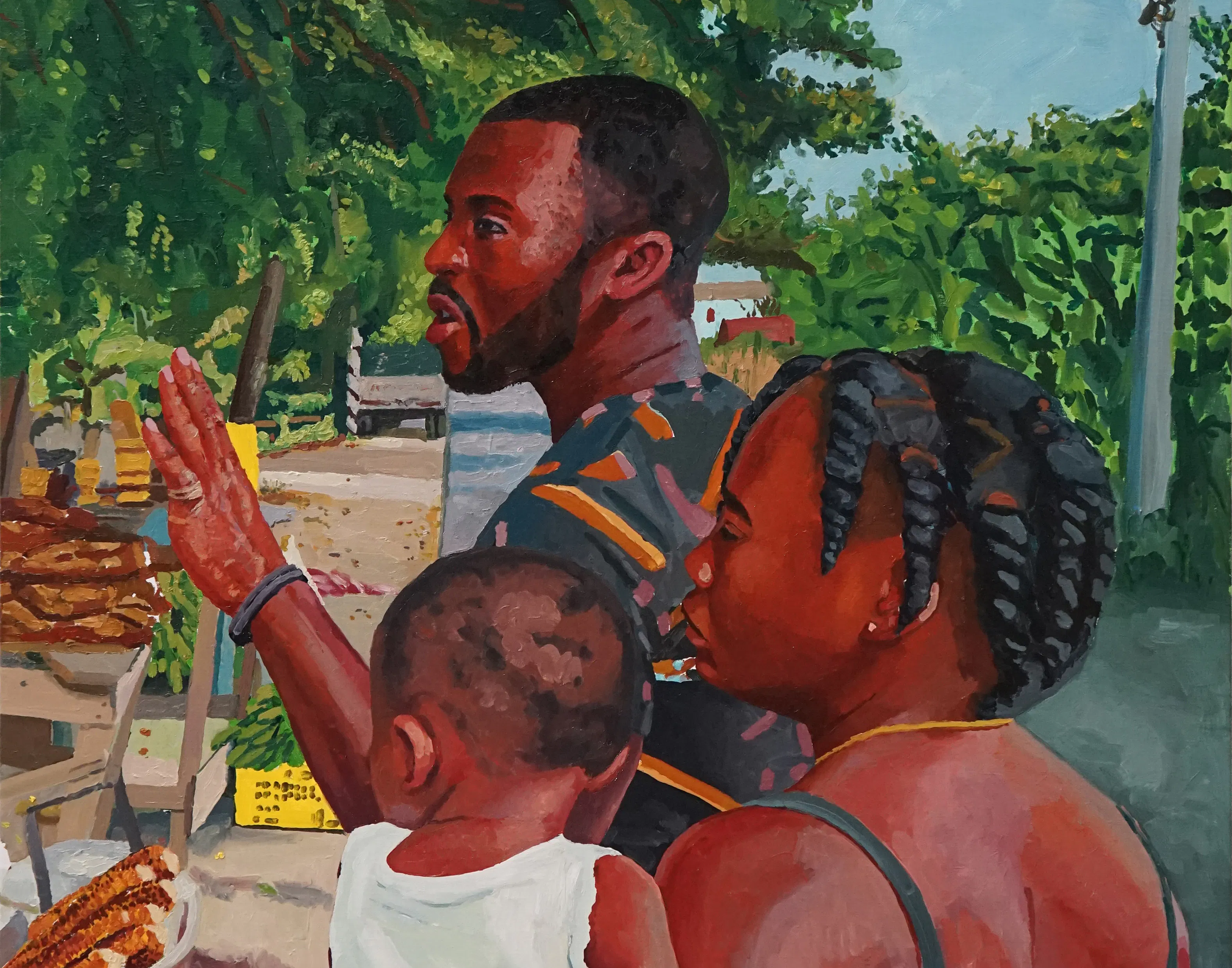
La Parada depicts a roadside ‘bodega’, one of many scattered across Dominican highways. Beneath the shade of trees, three figures stand with concentrated expressiveness, their attention fixed on someone outside the picture plane. The scene appears still, yet is charged with a social tension. Within this quiet and vibrant moment, Vasquez addresses larger, social and cultural forces at play: the transactional nature of tourism, the extractive economies that shape Dominican life, the asymmetries of access and benefit. What the painting both reveals and withholds speaks to the politics of place and value, and to who is at the margins of those exchanges.
Similarly, in ‘Study Walking Through’, a young boy carries a water container through his neighborhood in Mao. Rusted corrugated fences, a parked car, tufts of grass, and a canopy of leaves locate him in a specific landscape in Vasquez’ memory. The subject’s expression is inscrutable, illegible. Describing the work, Vasquez references his own reflections on the life that he has found himself inhabiting in the US. In this, the central figure becomes a cipher for a life he immigrated from. Here, the water container carries symbolic weight: Mao is a Taíno word that translates as a land between rivers.
Through these paintings, Vasquez constructs an archive of the everyday - gestures, environments, memories - with tender figuration. With a subtle gravity and a painterly precision, his paintings create surfaces wherein memory, place, and identity intersect, evoking the idea that memory resides not in the momentous, but in small, accretive moments: cast shadows, reflective pauses.