The Soft Spot opens in a state of rupture. Milea's paintings do not so much depict a world as enact its dissolution. A condition the artist describes as a fissure in a transparent screen, through which unthought-of colours begin to appear between self and world. Working in oil on canvas, linen, and plywood, the Romanian painter conjures images whose surfaces pulse with an iridescent darkness: teal, amber, bruised burgundy, and gold that seems less like light than like a substance held captive inside the figures themselves. The recurring presence of a glowing, aureate star, small and steady amid the tumult, anchors many of the compositions, a recurrent symbol that reads less as ornament than as an unextinguishable signal, a marker of inner location in an otherwise disoriented cosmos.
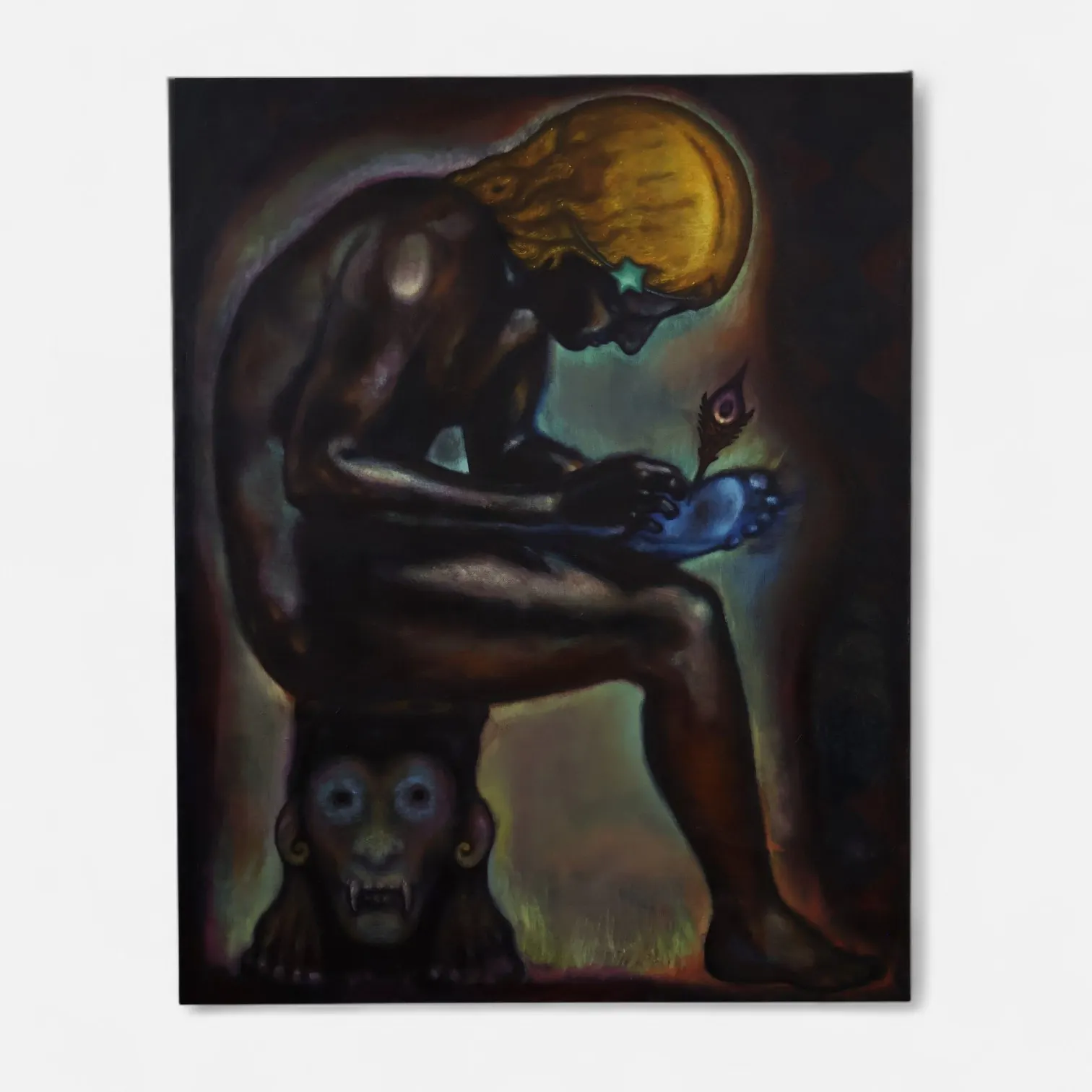
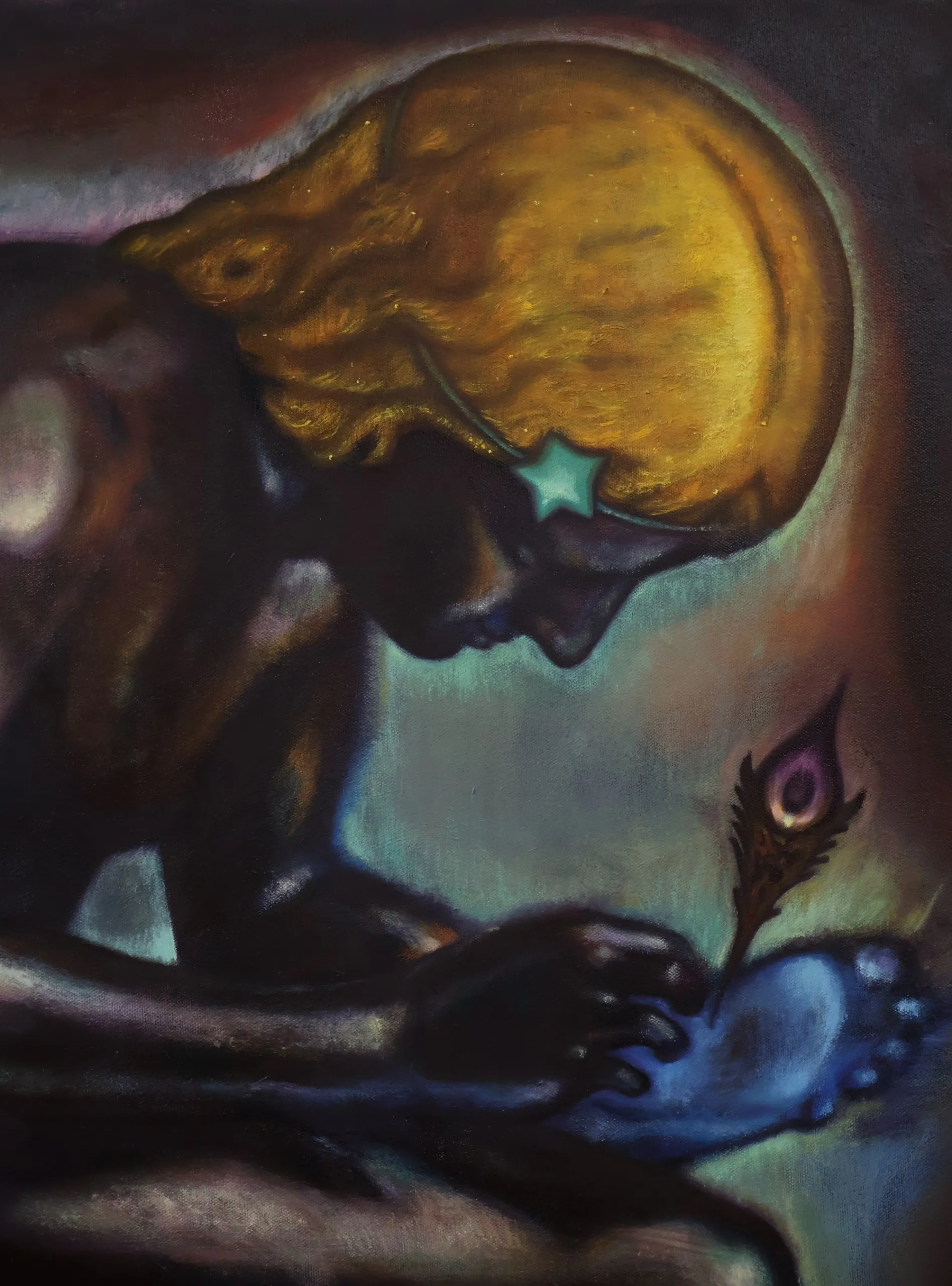
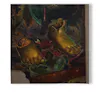
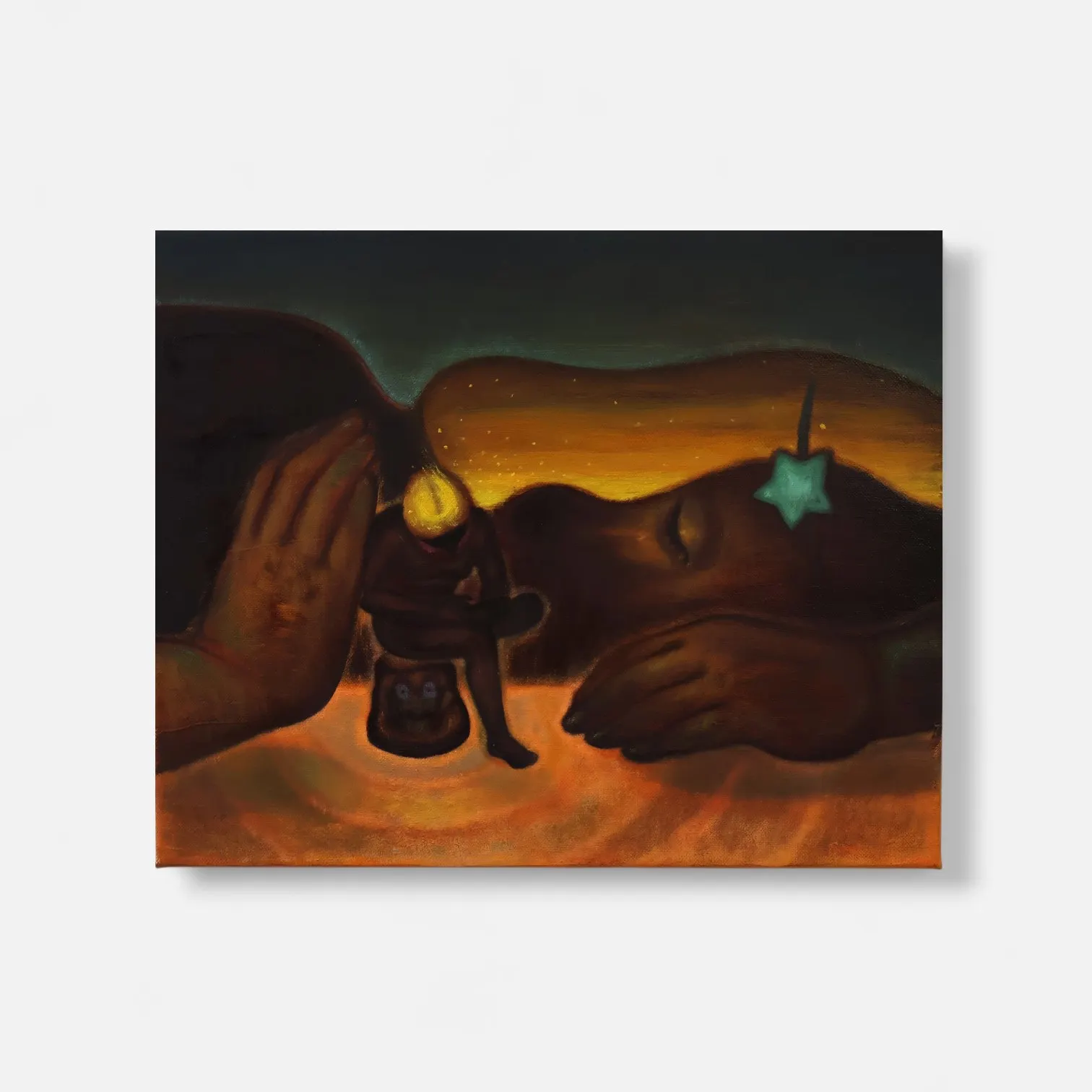
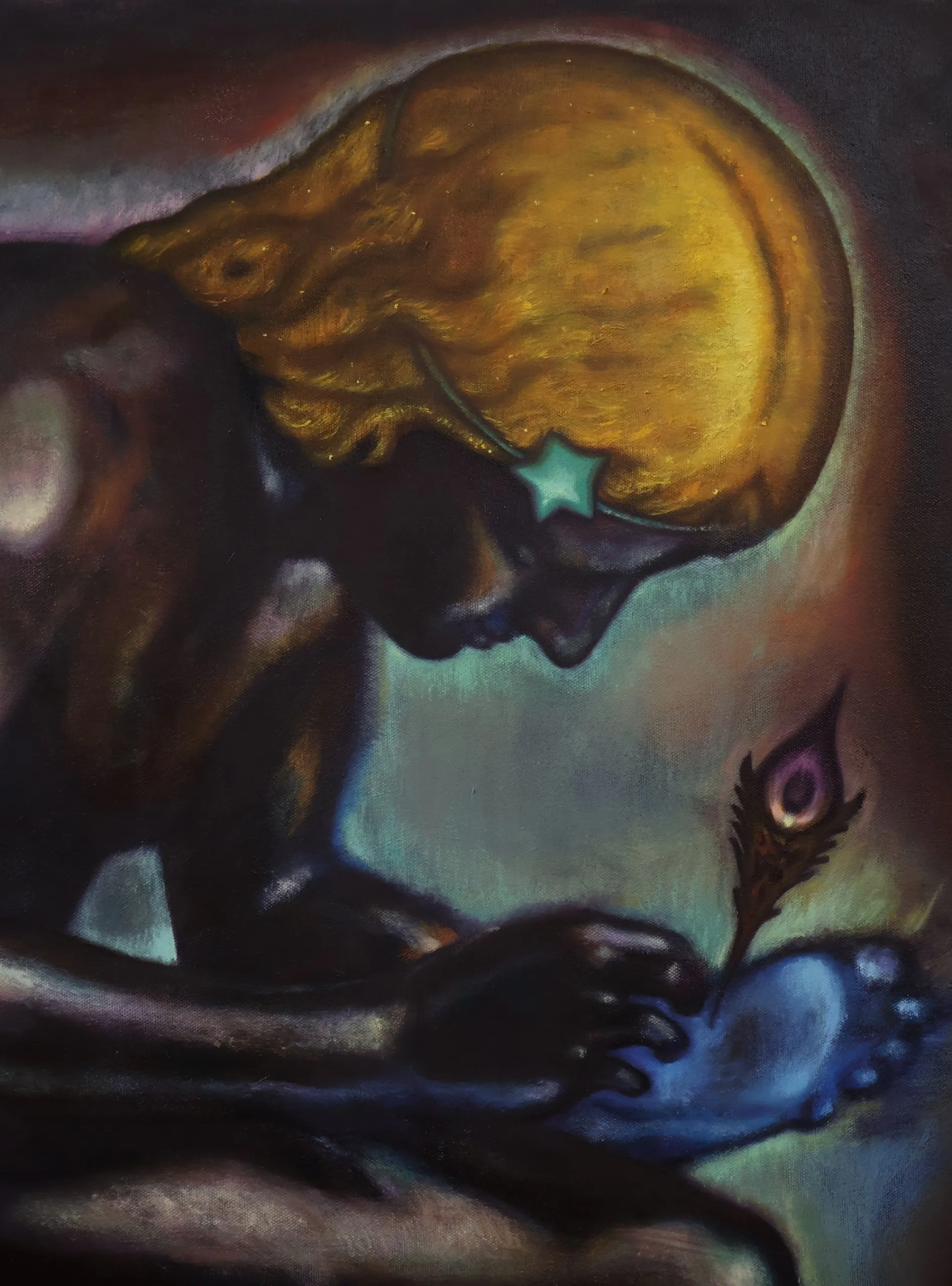
Milea's figures occupy mythic registers without subscribing to any fixed mythology. In The Soft Spot a great crouching body, its skin a dark iridescent bronze, bends in concentration, absorbed in the ancient gesture of the Spinario: the boy extracting a thorn from his own foot, here rendered as a peacock feather, an exchange that transforms a classical act of self-attention into something more charged and ambiguous. Below this figure, a wide-eyed creature with gilded ears and bared teeth stares outward with unsettling vacancy. The scale disparity between these two beings (the enormous and the diminutive) echoes throughout the series, creating an internal grammar of proportion that is simultaneously intimate and vertiginous. In Never alone, a reclining giant is traversed by a tiny figure at her torso beneath a starred amber sky; in I am Another, two figures whose faces are swallowed in shadow lean toward one another under a rust-coloured crescent moon. Their star-marked eyes are the only legible points of selfhood. Milea's compositions don't resolve; they hover between encounter and dissolution, presence and absorption.
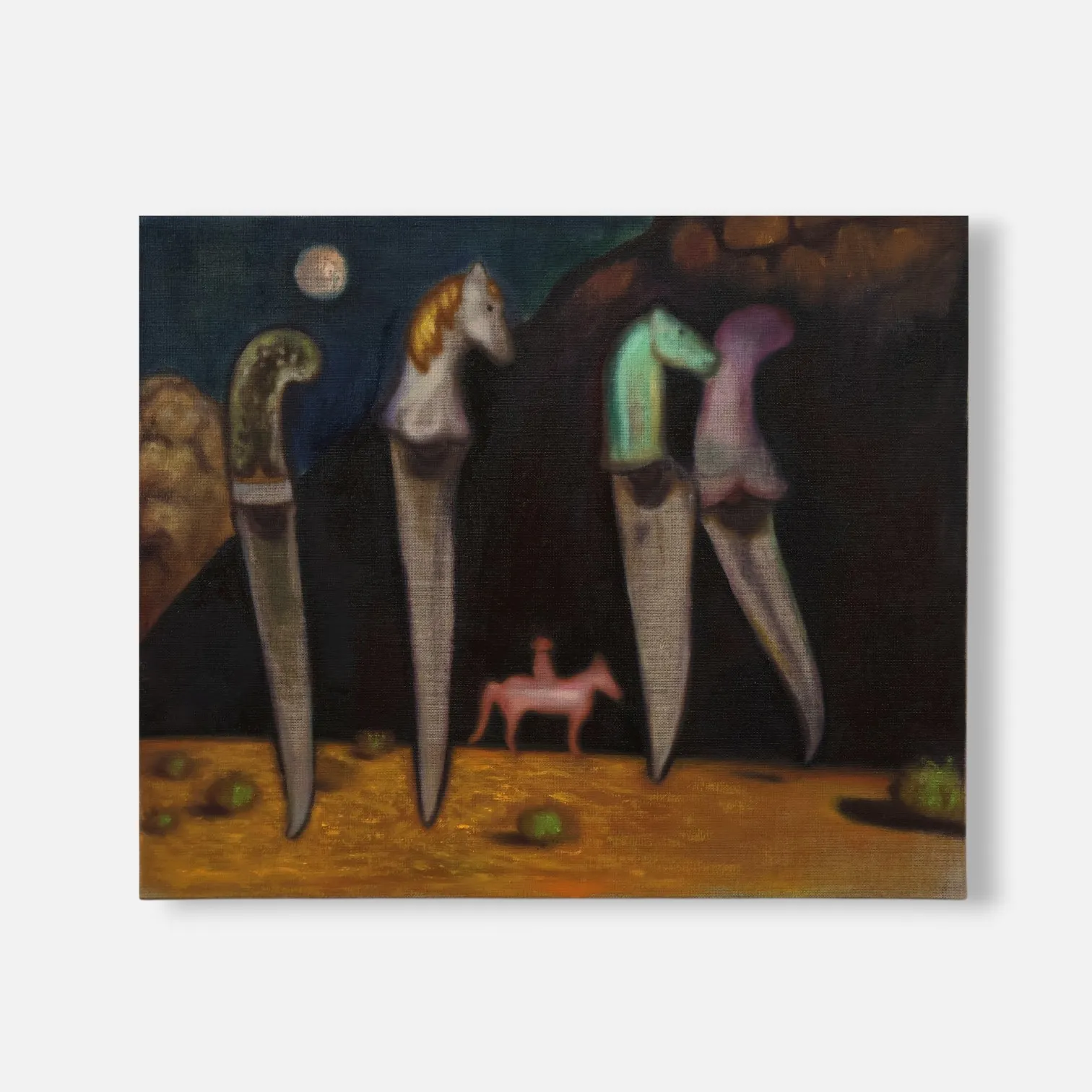
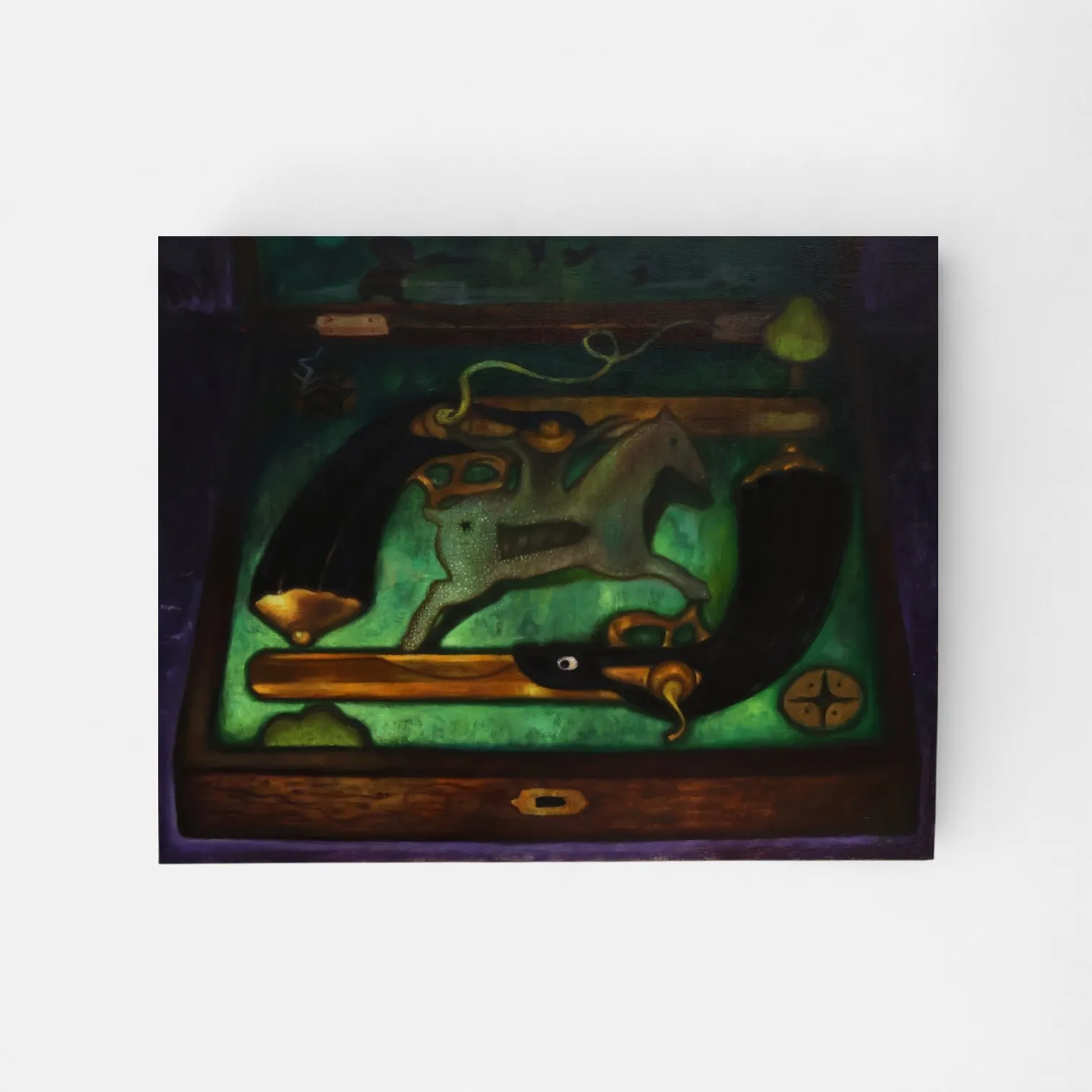
The influence of Hovsep Pushman is legible in Milea's sensibility, and her own account of discovering him is revealing: she describes his still lifes as forming figures from a continuous mystical matter, building scenographies of an inner waiting room in which objects become sacred leftovers lived, yet captive in a nocturnal and troubling stillness. This language of arrested presence, of things whose existence exceeds their occasion, permeates the exhibition. In Neverending Negotiation which functions almost as a still life within the series a deep green-lit case containing two pistols, a leaping horse figure, and a compass glows with the uneasy charge of relics, objects suspended outside narrative time. Imminent beings extends this uncanny suspension into the landscape: knife-like totemic forms thrust from an ochre ground beneath a pale moon, their handles bearing hybrid horse-human figures, a tiny pink rider dwarfed between them. Then I became weightless retreats further still, into pure fragment, two golden feet hover against a swirling baroque ground of red flowers and entwined ornament, disembodied and luminous, as if the body has already begun its dispersal.
Paul Gauguin exerts an equally formative pull, though Milea's reading of him is characteristically oblique. She is drawn not to the vivid surface of his palette but to what she identifies as the attractive and seductive darkness behind it: the figure of a painter expelled from Eden and still peeking through the keyhole — sentenced to be a witness with a violent dream. Like Gauguin's Tahitian tableaux, Milea's paintings stage an encounter between an observing consciousness and a world that does not fully accommodate it. But where Gauguin's gaze fixes its subjects, Milea dissolves the boundary between the seer and the seen. She does not watch the world through the keyhole; she has become the keyhole itself.
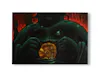
This dissolution finds further antecedents in the more esoteric strands of early twentieth-century painting. Agnes Pelton and Bolesław Biegas each sought to render states of consciousness that exceed visible form. Pelton through luminous geometric abstraction charged with spiritual intent; Biegas through a Symbolist figuration in which human and cosmic matter blur into one another, bodies stippled with the same substance as night sky and standing water. Milea inherits this tradition without its doctrinal certainty, replacing transcendence with permeability. Her figures don't ascend; they seep. Similarly, Michaël Borremans' uncanny portraits in which painted surfaces seem to question whether the thing depicted is alive, remembered, or fabricated; share with Milea's work a destabilisation of the viewed subject that implicates the viewer's own act of looking. And in the lush, enclosed world of The Unicorn in Captivity, with its teeming millefleurs ground and its central figure at once wounded and serene within its enclosure, one finds a precedent for Milea's own dense, layered compositions, where beauty and constraint, radiance and containment, exist in indissoluble tension. Marguerite Burnat-Provins, too, with her hybrid figures pressing the boundary between human and animal form, prefigures Milea's sense that the self is not a stable category but a permeable one, subject to metamorphosis from within. A tension made explicit in The Inside Outsider, where a vast, dark figure cradles a luminous golden face at its chest like a secret held just barely inside the body.
Milea, born in Bistrița and now living and working between Paris & Cluj, has spoken of her practice as a sustained exercise in sensorial awareness, an effort to capture the same presence across shifting forms, the impossible singularity of concrete reality. The works in this exhibition feel as though they emerge from the furthest end of that exercise, from the point at which the act of grasping the real begins to produce its opposite: not clarity but trans-materiality, not recognition but estrangement.
In The Soft Spot, Milea offers not a vision of the world but a vision of what happens when vision itself gives way. When the screen pierces, and strange creatures pass through.
References
1
2
3
4
5
6
7
8
Catalina Milea, The Soft Spot